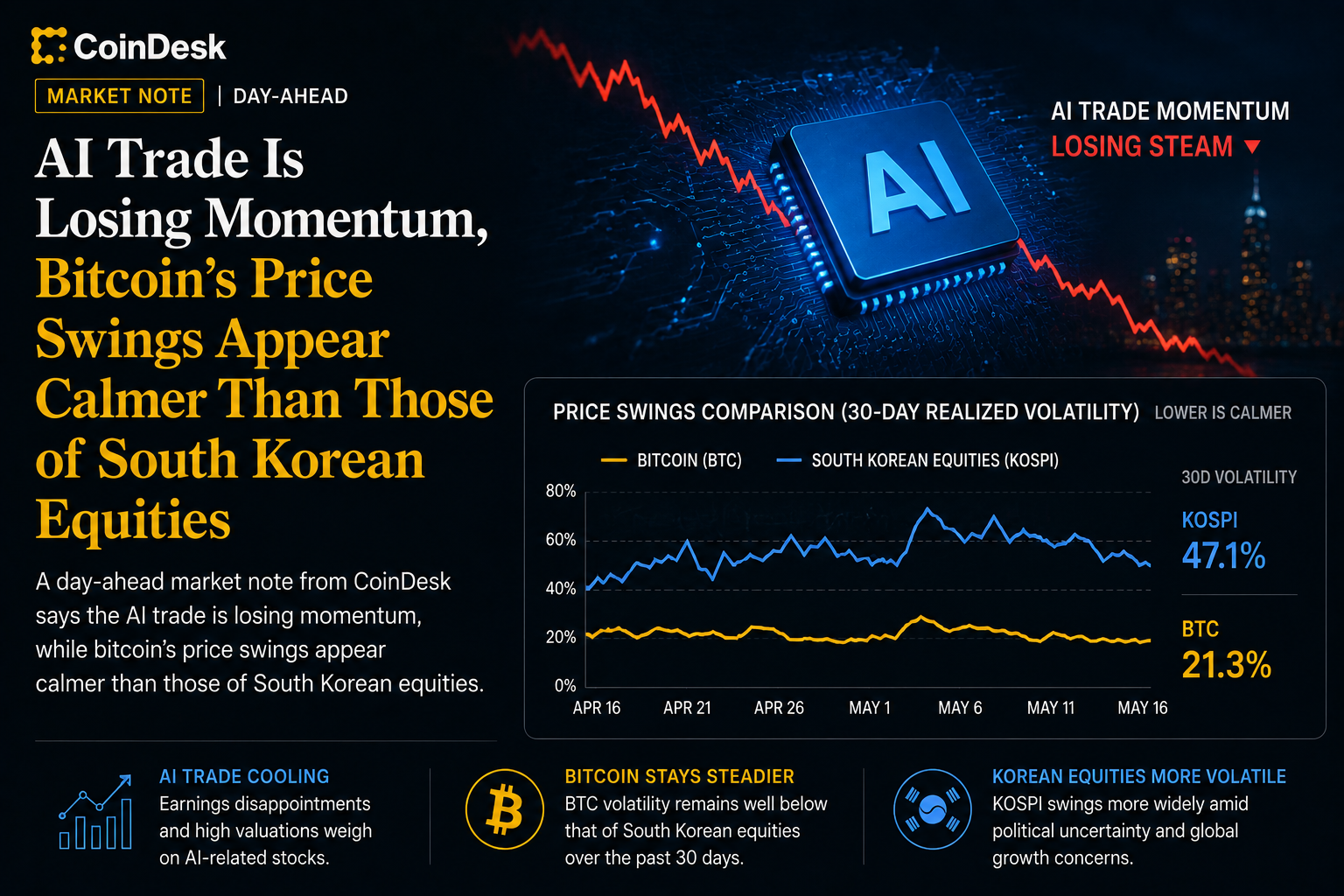
The latest day-ahead note from CoinDesk points to a notable shift in market behavior as the AI-driven equity trade loses some of its earlier momentum. Against that backdrop, bitcoin is being described as less volatile than South Korean stocks, a comparison that highlights how quickly relative risk perceptions can change across asset classes.
The broad takeaway is not that bitcoin has become a low-volatility asset in any absolute sense. Rather, the reference suggests that recent moves in some equity markets, particularly in South Korea, have been more pronounced than those in bitcoin. That kind of cross-asset comparison is useful for traders because it frames volatility in relative terms, not just by looking at a single chart in isolation.
CoinDesk’s market brief is set against a softer tone in the AI frenzy that has helped drive segments of the equity market over the past year. When a dominant narrative starts to cool, leadership in risk assets can shift quickly. In that environment, traders often reassess which positions still carry crowded expectations and which markets are showing steadier tape action.
Bitcoin’s role in that rotation remains complex. It is still widely treated as a risk asset in periods of stress, yet it can behave differently depending on liquidity conditions, macro headlines and positioning. The observation that it is less volatile than South Korean stocks on this day underscores that crypto does not always sit at the top of the risk spectrum, even when broader sentiment is cautious.
For market participants, the point is less about making a directional call on bitcoin and more about reading the current distribution of volatility across regions and sectors. South Korean equities have at times been a focal point for fast-moving retail and institutional flows, which can amplify swings when sentiment shifts. If the AI trade is fading, those swings may become even more visible as investors rebalance exposures.
The note is a reminder that volatility is not static and that leadership can change abruptly when a popular theme loses steam. In a market environment shaped by rotating narratives, bitcoin may sometimes look comparatively orderly, even if the asset remains inherently volatile by traditional standards.
As always, the comparison should be read carefully. It reflects a snapshot in time rather than a lasting structural change. Market conditions can reverse quickly, and relative calm in one asset class does not necessarily imply stability ahead.
Source: CoinDesk.