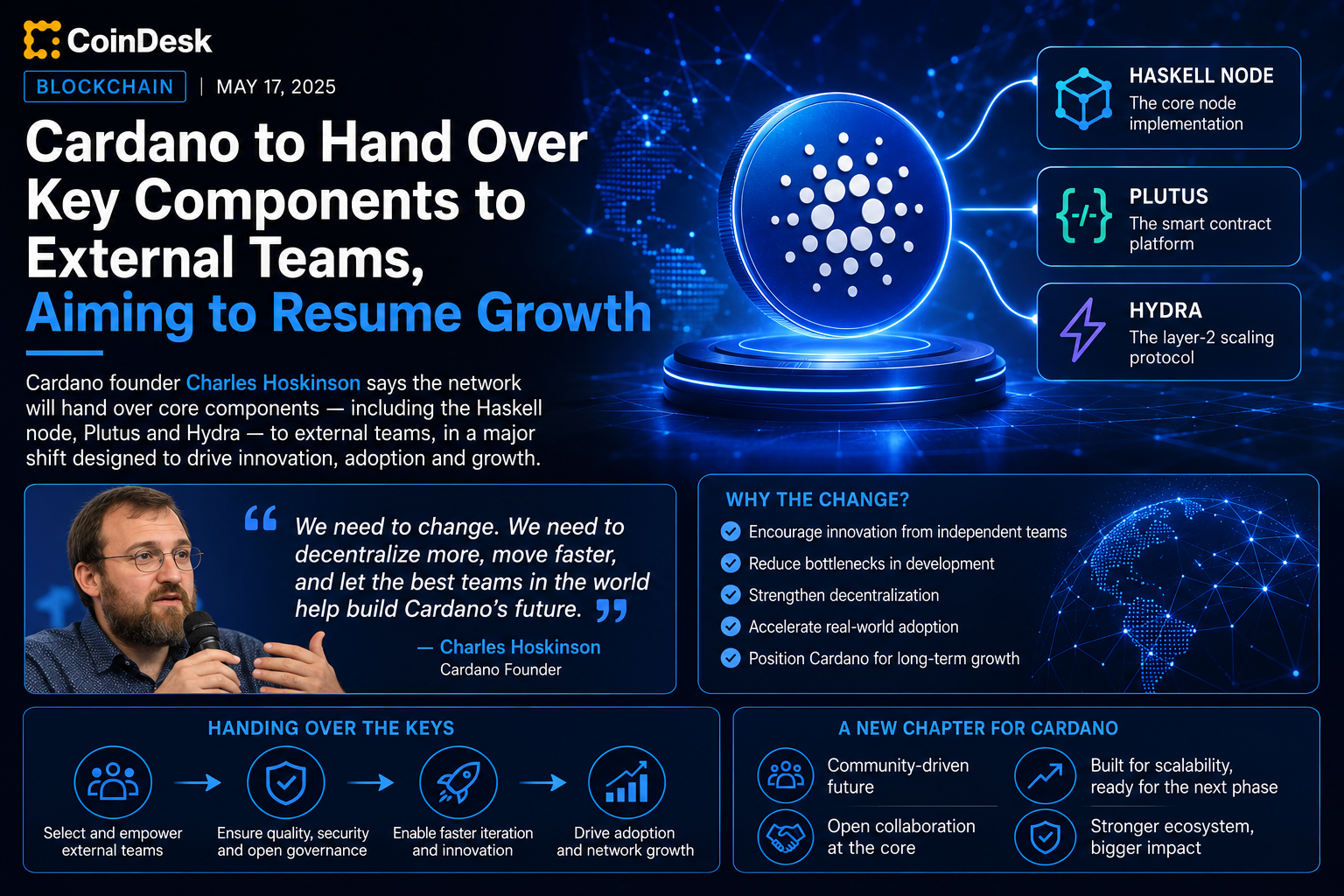
Cardano is moving core development responsibilities beyond its founding organization as part of a broader decentralization effort, according to CoinDesk. Input Output, the blockchain developer closely associated with the network, will transfer control of key components including the Haskell node, Plutus and Hydra to outside teams.
The shift marks a notable change in how the network is maintained. Those components sit near the center of Cardano’s technical stack, so handing them to external groups suggests a reworking of long-held development structure rather than a routine update. The move was framed by founder Charles Hoskinson as necessary because, in his view, the network must change and begin growing again.
The report did not specify which outside teams will assume responsibility, nor did it outline a timeline for the handoff. That leaves some uncertainty around how the transition will be managed and how quickly the new structure will take shape. Still, the direction is clear: Cardano is trying to push more of its core engineering work away from a single central entity.
For a blockchain ecosystem that has long emphasized decentralization at the protocol level, the latest step extends that idea to development itself. In practical terms, a wider distribution of maintenance and decision-making could reduce reliance on Input Output and potentially broaden participation in the network’s technical roadmap. It also introduces new questions about coordination, governance and consistency across major software components.
Cardano has been one of the more closely watched smart-contract platforms, and changes to its core development model may be seen by market participants as a signal of strategic reset. The immediate implications for users and developers were not detailed in the source report, and the extent to which the handoff affects releases, upgrades or ecosystem activity remains unclear.
Hoskinson’s comments suggest the move is meant to be more than symbolic. By transferring control of the Haskell node, Plutus, Hydra and related pieces, Cardano appears to be redefining how its infrastructure evolves. Whether that produces faster progress or simply a more dispersed development process will depend on execution, which remains to be seen.
Source: CoinDesk