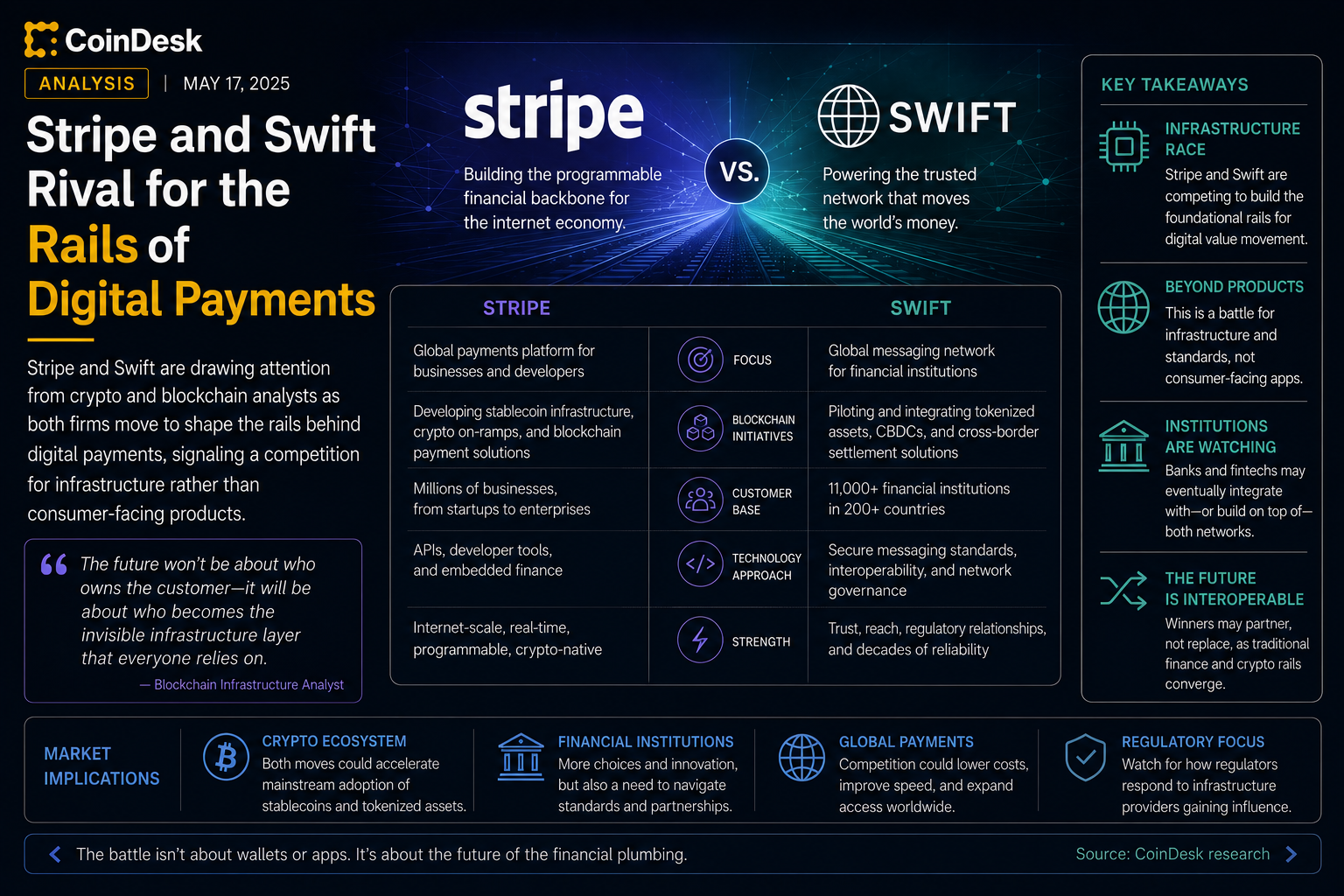
Stripe and Swift are increasingly being viewed as competitors in the race to define the next generation of global payments infrastructure, according to crypto and blockchain experts cited in CoinDesk.
The broad takeaway from this week’s developments is not that the two firms are battling over the same consumer payments products, but that both are seeking influence over the underlying systems that move money across borders and between institutions. That shift matters for digital assets and blockchain infrastructure because the companies that control payments rails often shape how fast, cheap and interoperable transactions can become.
Stripe has long been associated with software-driven payments for online businesses, while Swift remains central to cross-border bank messaging and settlement coordination. The latest moves, as described by market observers, suggest the two are converging on a similar strategic question: who will own the plumbing for digital payments as financial infrastructure becomes more programmable and more global.
For the crypto sector, the competitive dynamic is notable because it reflects continued interest from established financial companies in the same infrastructure layer that blockchain proponents have targeted for years. Analysts and industry participants often frame that layer as where the most meaningful change in payments could occur, even if end users never directly interact with the underlying systems.
CoinDesk reported that experts see this week’s developments as evidence of a broader contest for control over payments architecture. The report did not indicate that either company has disclosed a full plan to overhaul the system on its own, and the strategic implications remain subject to interpretation. Still, the direction of travel is clear: financial infrastructure is becoming a more active area of competition.
That competition could have implications for digital payments broadly, including how traditional institutions interact with blockchain-based systems and whether new rails are built to connect, rather than replace, existing networks. It may also influence where capital and engineering attention flow next, especially among firms building tooling for cross-border transfers, settlement and compliance.
For now, the story is less about a single product launch than about positioning. Stripe and Swift each bring different strengths, but both appear intent on staying central as payments infrastructure evolves. Market participants watching the sector are likely to see this as another sign that the race to modernize global money movement is moving deeper into the institutional layer.