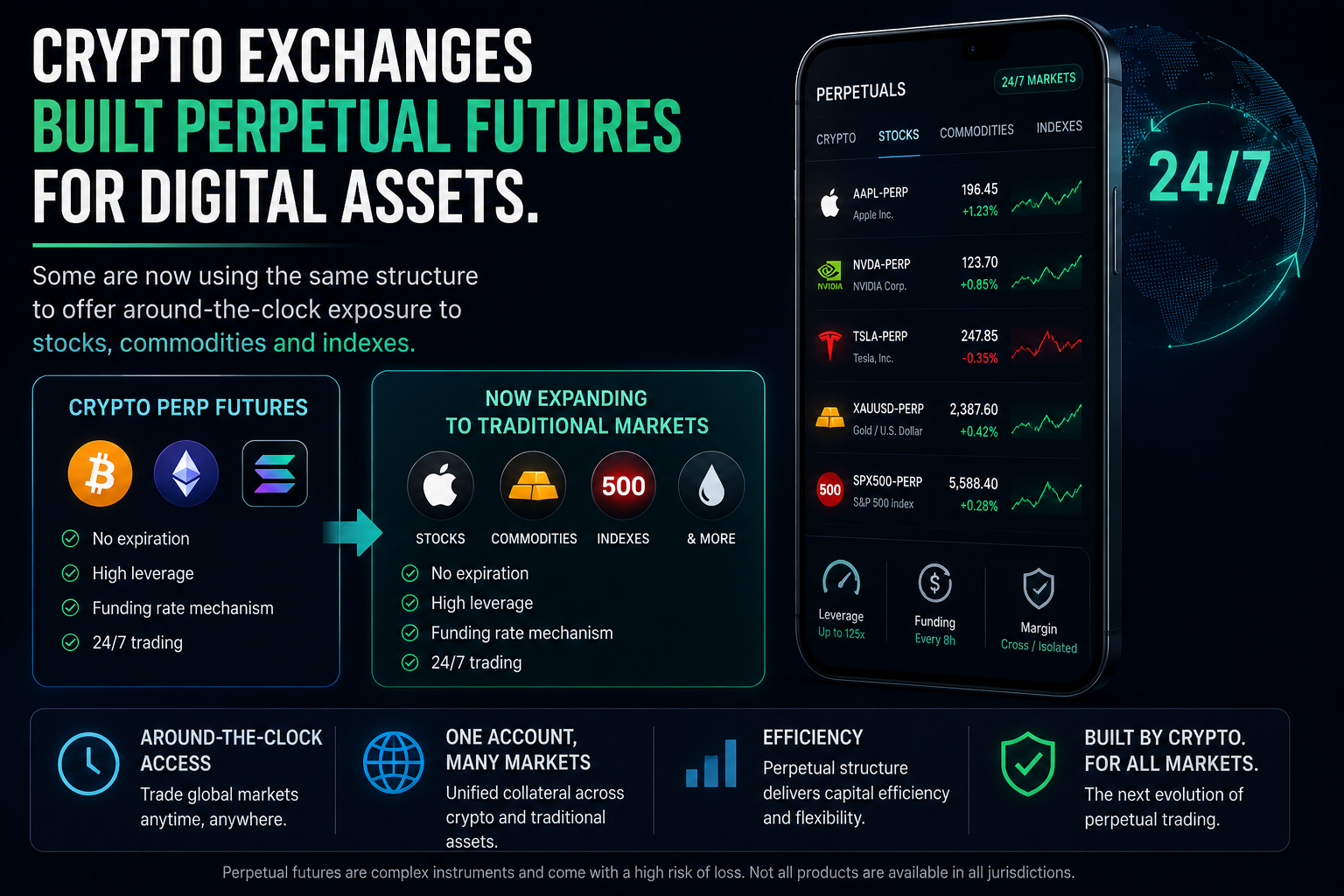
Crypto exchanges are increasingly applying one of the market’s defining products to assets far beyond digital tokens. Perpetual futures, or perps, which helped shape crypto trading by letting investors take leveraged exposure without an expiry date, are now being used to package access to stocks, commodities and indexes.
The shift marks a kind of reverse bridge between crypto and Wall Street. For years, traditional finance firms explored ways to bring equities and other conventional assets onchain or into tokenized form. Now, crypto-native venues are taking a product that grew out of digital-asset markets and extending it toward the broader financial system.
The appeal is straightforward. Perps are designed for continuous trading, and that makes them a natural fit for markets that do not align neatly with crypto’s 24/7 structure. By using the same contract format, exchanges can offer constant exposure rather than forcing traders to wait for a regular market open. That may be particularly relevant for global users who want access outside standard U.S. trading hours.
The development also underscores how crypto exchanges are looking to broaden their product mix as competition intensifies in digital assets. Instead of relying solely on spot trading and token listings, venues are increasingly leaning on derivatives to draw activity and keep users on-platform. Expanding perps to traditional market references may be another way to capture demand from traders who are already comfortable with the structure.
At the same time, the move raises familiar questions about market design, risk and suitability. Perpetual futures are a leveraged derivative, and their behavior can differ sharply from owning the underlying asset directly. That is true in crypto and likely remains true when the reference is a stock, commodity or index. The lack of an expiry date can make these products convenient, but it also means traders need to pay close attention to funding dynamics and price tracking.
Details remain limited from the available report, and it is not yet clear how broadly these products will be distributed or how regulators will view them across jurisdictions. Still, the direction is notable. What began as a crypto-native workaround for continuous exposure is becoming a template for offering traditional market access in a format familiar to digital-asset traders.
For the industry, that suggests perps are no longer just a crypto market feature. They are becoming a cross-asset trading rail, with exchanges using them to test where the boundary between digital and traditional finance may now sit.
Project Visibility on ChainBrief
Sponsored coverage and project placements for Web3 teams.