A draft Ethereum proposal could sharply change the network’s economics if staking continues to expand.
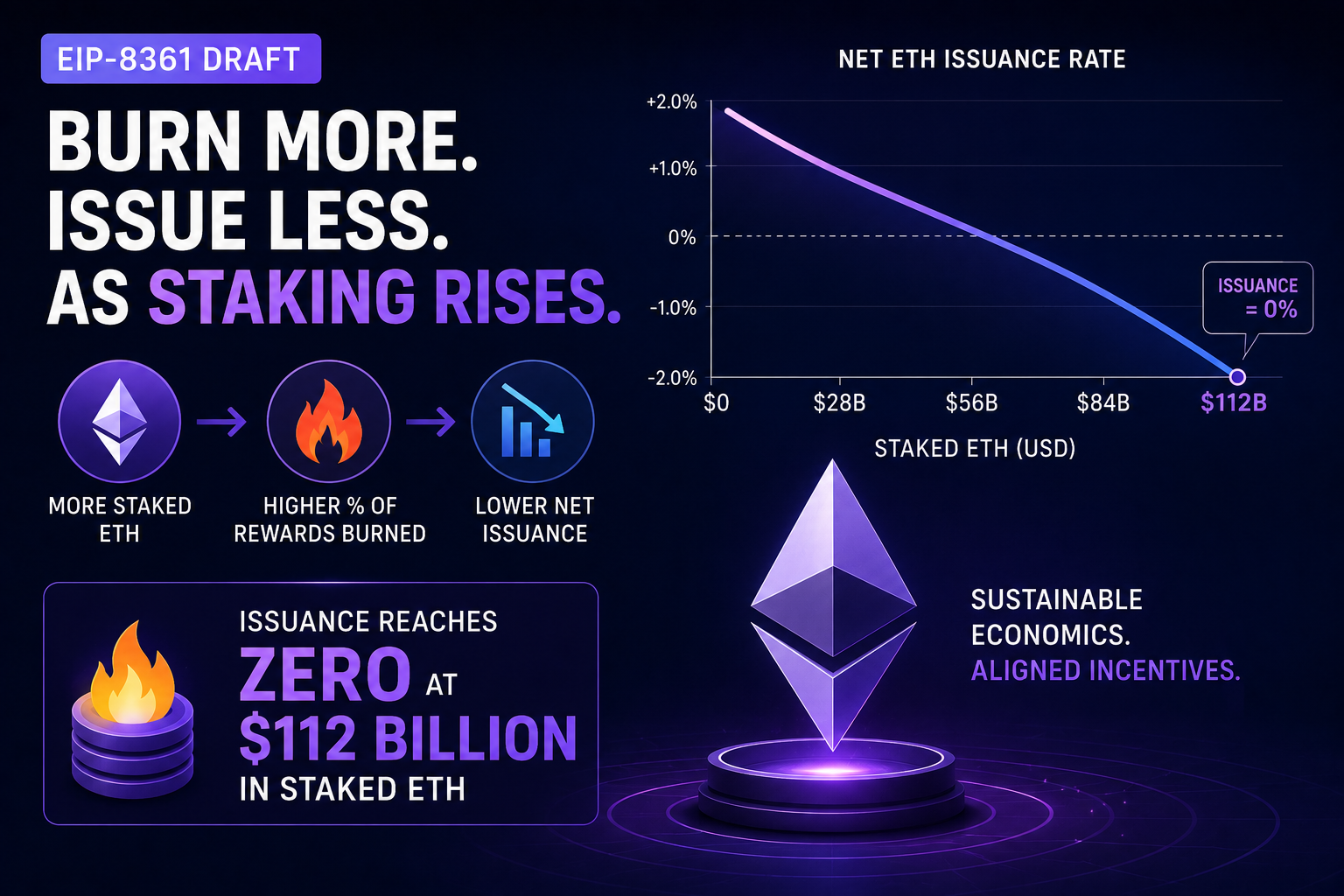
The proposal, identified as EIP-8361, would burn an increasing portion of validator rewards as the staking ratio climbs, according to CoinDesk. In its most aggressive form, issuance would fall to zero if the amount of staked ETH reaches $112 billion.
The idea places Ethereum’s monetary policy more directly in line with network participation. As more ETH is locked in staking, the draft seeks to offset new issuance by reducing or eliminating rewards, rather than letting supply expand at the same pace. The proposal is still at the draft stage, and the available details suggest it is a framework for discussion rather than a finalized change.
If implemented, the mechanism would give Ethereum a more dynamic issuance model. Validator rewards would not remain fixed. Instead, they would decline as the staking ratio rises, with the burn rate increasing progressively. That structure could make the network’s supply profile more sensitive to staking demand, though the exact effect would depend on how the proposal is ultimately written and adopted.
The threshold cited in the draft is $112 billion in staked ETH, a level that would trigger zero issuance under the proposal’s design. CoinDesk did not provide further details on timing, implementation, or consensus support. As with any Ethereum protocol idea, the proposal would need to move through the network’s governance and technical review process before it could become part of the chain.
Ethereum’s staking system already plays a central role in network security and token economics. A proposal that ties issuance more tightly to staking levels would likely attract attention from validators and market participants alike, but for now the concept remains a draft with uncertain prospects.
For now, EIP-8361 adds another data point to the broader debate over Ethereum’s long-term supply policy. Whether the network ultimately adopts the idea is unclear.