Polymarket Pursues U.S. Approval for Margin Trading as Prediction Markets Expand
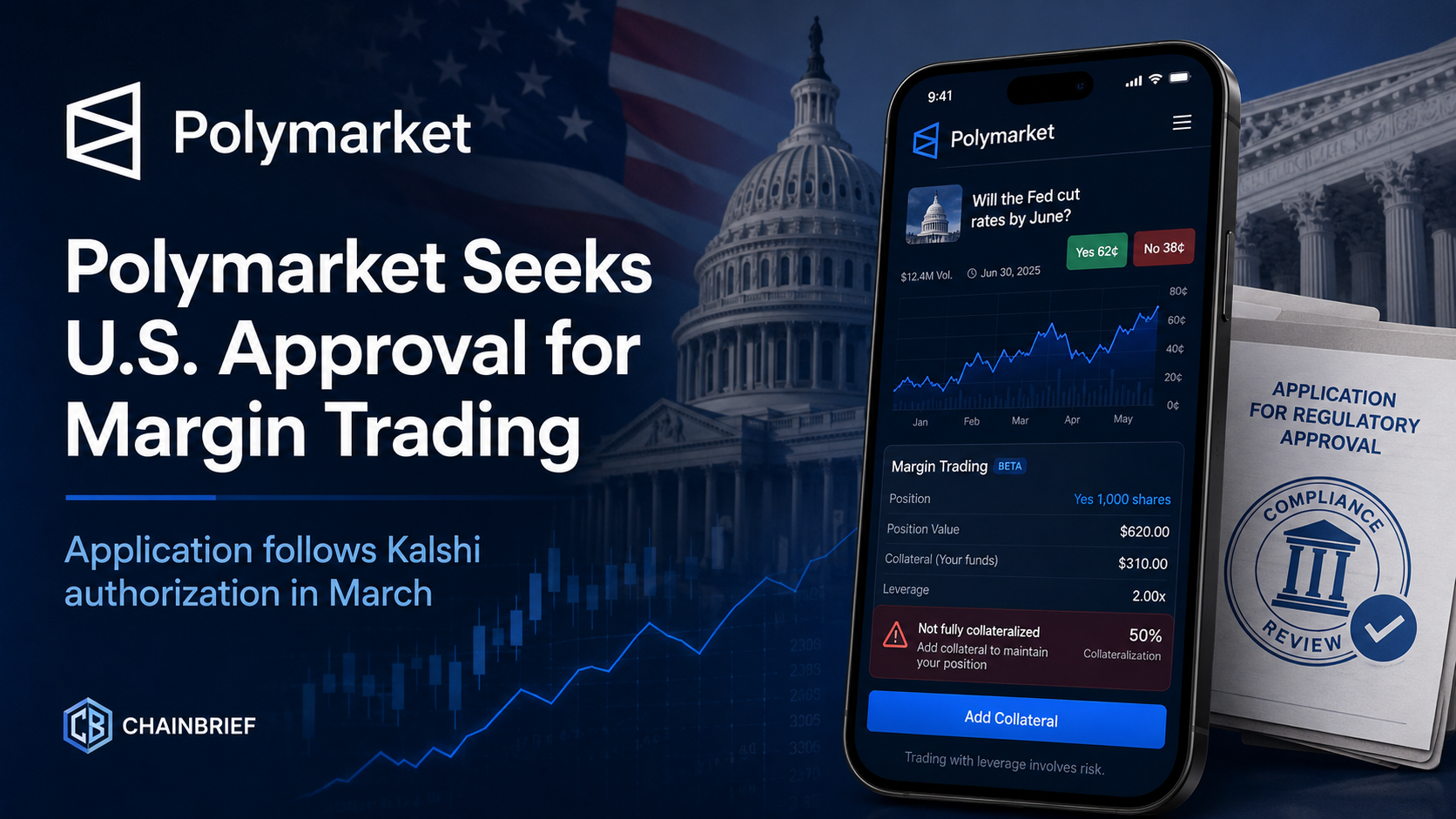
Polymarket is seeking regulatory approval to introduce margin trading for customers in the United States, a move that could allow users to open prediction market positions without providing the full value of each trade upfront.
The company’s U.S. affiliate has applied for registration as a futures commission merchant with the National Futures Association, according to a report published by CoinDesk. Polymarket would also need approval from the Commodity Futures Trading Commission to amend its rules and support positions that are not fully collateralized.
The application represents an early regulatory step rather than approval to launch the service. Polymarket has not yet confirmed when margin trading could become available or which customers and contracts would initially qualify.
Moving Beyond Fully Collateralized Trading
Polymarket’s current U.S. market structure is based on fully collateralized contracts.
Under the company’s existing clearing rules, the financial obligations attached to a fully collateralized contract are paid when the position is opened. No additional amount is subsequently due for margin or settlement.
This structure limits the possibility that a trader will be unable to meet an obligation when a contract settles. It also requires users to commit enough capital to cover the full potential exposure associated with each position.
Margin trading would change that arrangement by allowing qualifying users to provide only part of the capital required to support a position.
The remaining exposure would be managed through collateral requirements, risk controls and procedures designed to close or reduce positions when account values fall below required levels.
This could make capital use more efficient, particularly for professional traders and market makers managing several positions. It would also introduce additional risk because losses could exceed the amount a user initially allocated to a trade.
Why Polymarket Needs More Than One Approval
Applying for registration as a futures commission merchant is only one part of the process.
A futures commission merchant can accept customer orders and hold funds or collateral connected with futures and other regulated derivatives. Registration requires applicants to meet financial, operational and compliance standards established by U.S. regulators and the National Futures Association.
Polymarket would also need the CFTC to approve changes to the rules governing its U.S. exchange and clearing operations.
Its existing U.S. rulebook already contains provisions related to futures commission merchants, customer accounts, collateral and margin. However, the framework continues to identify fully collateralized positions as the basis for the contracts currently offered.
Regulatory approval would therefore need to cover not only the affiliated intermediary but also the market and clearing rules used to manage positions that are not funded in full.
Kalshi Received Similar Clearance
Polymarket’s application follows a similar regulatory move by competing prediction market operator Kalshi, which received clearance to introduce margin trading in March.
That decision gave Kalshi an earlier opportunity to develop products that require less capital to open and maintain than fully collateralized contracts.
For Polymarket, securing equivalent permissions could help it compete for professional traders, liquidity providers and other customers who use margin across traditional derivatives markets.
Margin access may be particularly relevant to firms running several related positions at the same time. Requiring full collateral for every contract can tie up substantial capital, even when some positions partially offset one another.
However, Polymarket has not disclosed the margin levels, eligible customer categories or liquidation procedures it would apply. These details would determine how much additional exposure users could take and how the platform would manage potential losses.
A New Stage in Polymarket’s U.S. Return
The application is part of Polymarket’s broader effort to establish a regulated presence in the United States.
In January 2022, the CFTC ordered the company to pay a $1.4 million civil monetary penalty and wind down markets that did not comply with U.S. commodities law. The regulator said Polymarket had offered event-based binary options without obtaining the required registration.
The company’s current U.S. operation is structured separately under registered market infrastructure and uses a different framework from the international platform.
Introducing margin trading would represent a significant expansion of that regulated U.S. business. It would move the platform closer to the operating model used by conventional derivatives exchanges, where customers commonly post collateral rather than funding every position in full.
The proposal also comes as regulators pay closer attention to conduct inside prediction markets.
In February, the CFTC issued an advisory after enforcement cases involving fraud and the misuse of nonpublic information on prediction market contracts. The regulator said existing anti-fraud and anti-manipulation rules apply to these markets.
Margin trading could increase the size of positions users are able to control, making surveillance, collateral management and customer risk checks increasingly important.
What Approval Would Mean for Customers
Should Polymarket receive the required permissions, margin trading could allow eligible customers to use less upfront capital when opening positions.
That does not necessarily mean every retail user would immediately receive access. Regulators and the platform could restrict the service to particular customer groups, contract types or account sizes.
The platform would also need to establish margin calculation methods, collateral requirements, position limits and procedures for accounts that no longer meet minimum funding thresholds.
Because prediction market contracts can move sharply when new information emerges or an event reaches its resolution, the risk model may differ from those used for traditional futures based on continuously traded assets.
A contract linked to an election, court ruling or economic announcement could change in value quickly after a decisive development. Margin systems would need to account for those sudden moves and the limited time available to close positions before settlement.
The Application Is Not Yet a Product Launch
Polymarket’s filing signals its intention to expand the services available through its U.S. platform, but margin trading remains subject to regulatory review.
The company still needs the appropriate registrations and approval for the rule changes required to support positions that are not fully collateralized.
Until those steps are completed, Polymarket’s U.S. customers will continue operating under the existing market structure.
The eventual impact will depend on the conditions attached to any approval, the customers permitted to use margin and the risk controls introduced alongside the service.
Sources
CoinDesk report on Polymarket’s application for U.S. margin-trading approval.
Polymarket US Rulebook filed with the Commodity Futures Trading Commission.
Polymarket Clearing Rulebook filed with the Commodity Futures Trading Commission.
Commodity Futures Trading Commission enforcement order involving Polymarket.
Commodity Futures Trading Commission prediction markets enforcement advisory.
Disclaimer:
This article is for informational purposes only and does not constitute financial, legal, investment or trading advice. Margin trading can increase potential losses and may not be suitable for all market participants.