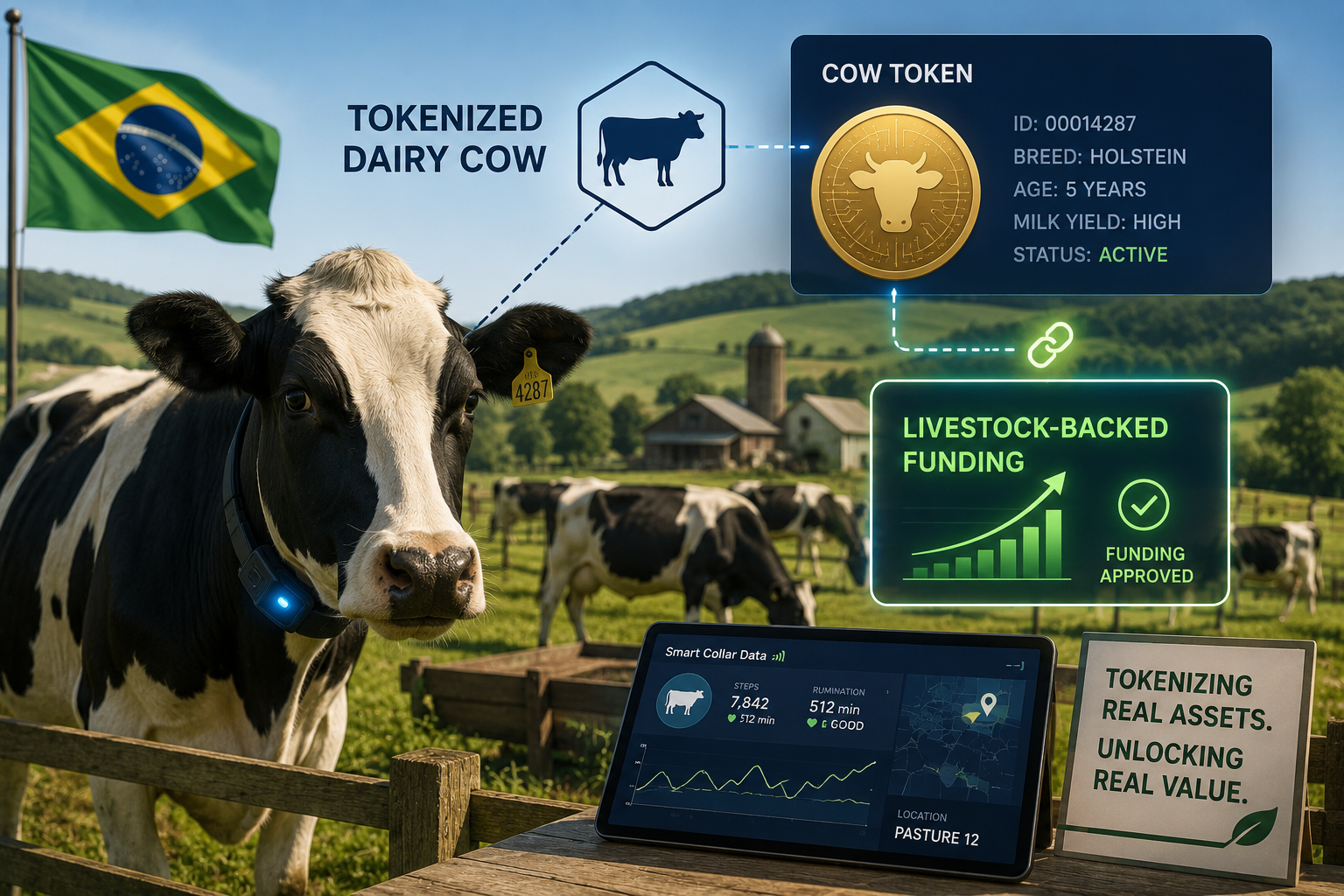
Brazilian farmers are turning to tokenized dairy cows as a way to access financing when traditional bank lending can be restrictive, according to CoinDesk.
The setup uses smart collars that monitor herd health in real time, helping lenders and other funding providers track the animals that back the loans. The monitoring is designed to reduce fraud risk and provide more confidence that the livestock collateral remains in place and in usable condition.
In practice, the approach lets local agricultural businesses secure thousands of dollars in funding backed by cattle, while sidestepping lending limits that can make conventional credit harder to obtain. The structure appears aimed at improving access to capital in a sector where assets are physical, recurring oversight matters, and borrower transparency can be difficult to verify on a day-to-day basis.
The use of tokenization in this case reflects a broader trend in which real-world assets are being represented digitally to support financing, recordkeeping, or transferability. Here, the underlying asset is not a financial instrument but livestock, with the tokenized arrangement tied to the health and presence of dairy cows on farms in Brazil.
Details in the report are limited, including the exact size of the program, the lending counterparties involved, and whether the structure is being used broadly or only in a narrow set of transactions. Still, the example highlights how tokenization is moving beyond market speculation and into ordinary business finance, especially in sectors where collateral is tangible and easily monitored.
For agriculture businesses, the appeal is straightforward: faster or more flexible access to funding without depending solely on standard bank credit channels. For lenders and financiers, the appeal lies in the added visibility provided by sensor-based monitoring, which may help limit disputes over collateral status.
The development does not by itself establish a wider market trend, but it adds another data point to the growing use of blockchain-linked tools in asset-backed finance. As with other tokenized real-world asset structures, the effectiveness of the model will likely depend on enforcement, data reliability and local regulatory treatment.
Source: CoinDesk.