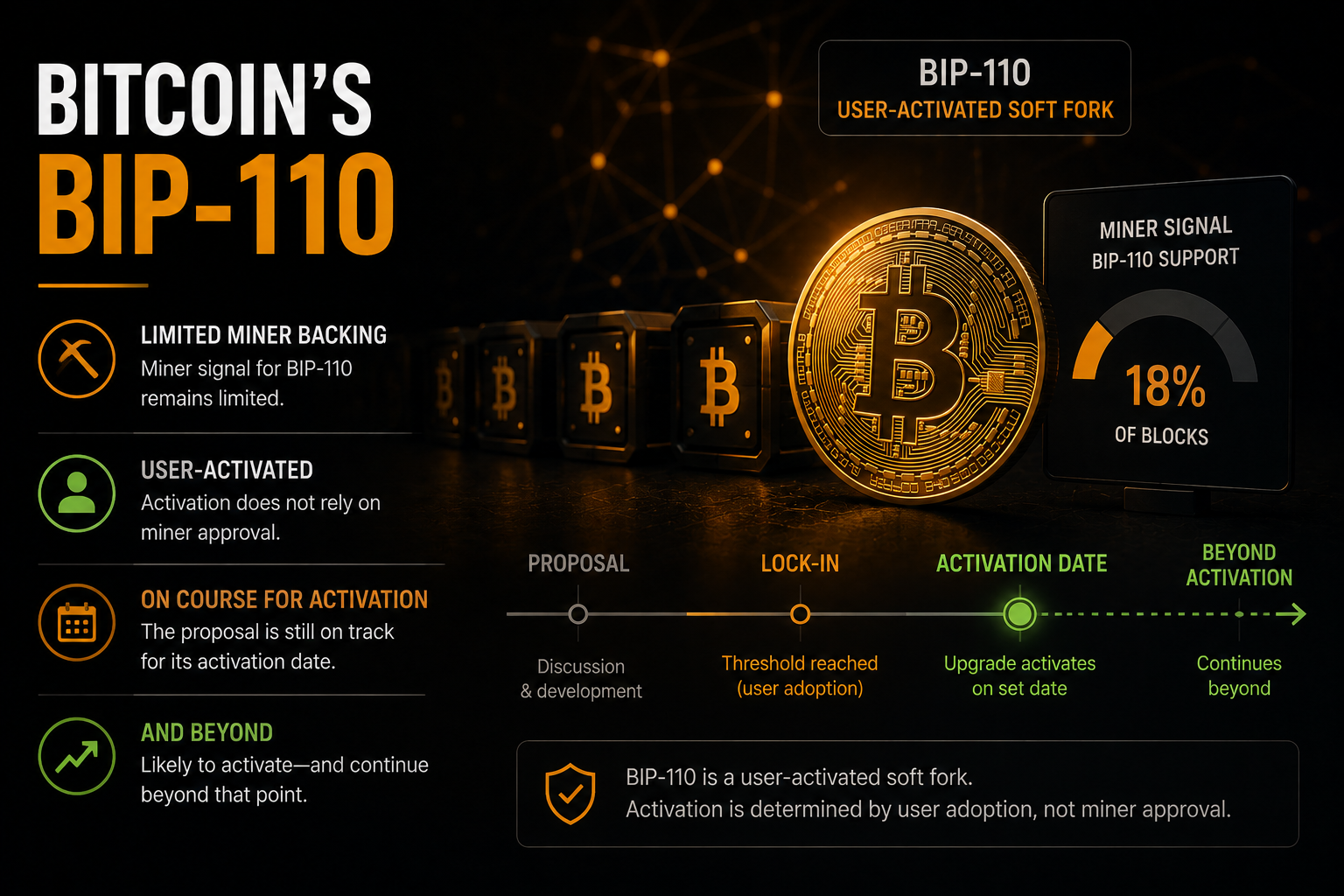
Bitcoin proposal BIP-110 is still advancing despite attracting only minimal support from miners, underscoring a familiar tension in the network between user-driven coordination and miner signaling.
According to CoinDesk, the proposal has gained only a sliver of miner support. Even so, its user-activated design means it continues toward its planned activation date and, most likely, past it. That structure makes BIP-110 notable less for broad consensus than for the way it can keep progressing without clear miner endorsement.
The dynamic matters because miner support is often treated as an important indicator of whether a Bitcoin change has practical momentum. In this case, the lack of backing does not appear to be enough to halt the proposal on its own. Instead, BIP-110 is moving through a process that gives users a larger role in determining whether it advances.
For market participants, the immediate takeaway is not that a major shift is imminent, but that the proposal remains alive even with weak miner participation. That can keep it on the radar for developers, node operators and traders tracking Bitcoin governance issues. Still, the available information suggests caution in reading too much into the proposal's persistence. The source material does not indicate a broad industry consensus, nor does it suggest near-term certainty around outcomes beyond the scheduled timeline.
BIP-110's endurance also highlights a recurring feature of Bitcoin decision-making: proposals can remain in motion even when support is fragmented. In practice, that can create extended periods of uncertainty as the network absorbs signals from different constituencies. Whether the proposal ultimately gains broader backing is not clear from the current data.
For now, the key point is simple. BIP-110 is not disappearing despite weak miner support. Its user-activated design gives it a path forward, at least through the activation date, and likely beyond it, keeping the proposal relevant in Bitcoin's ongoing governance debate.